Redis support via Jedis client#212
Conversation


…oot-jdbc to spring-boot-jdbc-redis
 palazzem
added
inst: others
palazzem
added
inst: others

|
Hey @gihad, If you're not comfortable with that, or you don't have more time to commit let me know. |

| span.setTag(DDTags.RESOURCE_NAME, command.name()); | ||
| span.setTag(DDTags.SERVICE_NAME, "redis"); | ||
| span.setTag(DDTags.SPAN_TYPE, "redis"); | ||
| span.setTag("span.origin.type", command.getClass().getName()); |
There was a problem hiding this comment.
If the command class is always the same, then this tag is probably not useful. I added that in other instrumentation because that can be an important tool for debugging.
There was a problem hiding this comment.
Makes sense. Will remove.
| Tags.SPAN_KIND.set(span, Tags.SPAN_KIND_CLIENT); | ||
| Tags.COMPONENT.set(span, "redis-command"); | ||
|
|
||
| span.setTag(DDTags.RESOURCE_NAME, command.name()); |
There was a problem hiding this comment.
What are some examples of command.name()? Does this have the right level of cardinality to be useful?
It would be nice if we could name the resource off of more than just the command name, but perhaps the full command (assuming it doesn't change a lot). Though based on your PR description, it sounds like this isn't possible.
There was a problem hiding this comment.
Examples of commands are SET, GET, ZRANK and all the other redis commands described here: https://github.com/xetorthio/jedis/blob/2.9/src/main/java/redis/clients/jedis/Protocol.java#L244
I think even at this granularity it is useful
Having the command name + the arguments to the command instead is something I listed in the PR description as a possible improvement, however there are some things to consider:
The datadog ruby APM does that (SETEX command + arguments):
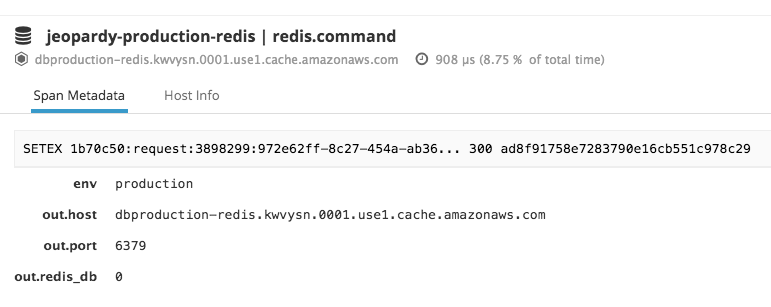
The NewRelic and Glowroot Java APM for redis only list the Commands like this one. I suspect it has something to do with how the Jedis code is laid out. There are 3 methods:
Method 1:
 protected Connection sendCommand(final Command cmd, final String... args) {
    final byte[][] bargs = new byte[args.length][];
    for (int i = 0; i < args.length; i++) {
      bargs[i] = SafeEncoder.encode(args[i]);
    }
    return sendCommand(cmd, bargs);
  }
Method 2:
protected Connection sendCommand(final Command cmd) {
   // declared above private static final byte[][] EMPTY_ARGS = new byte[0][];
    return sendCommand(cmd, EMPTY_ARGS);
  }
Method 3:
protected Connection sendCommand(final Command cmd, final byte[]... args) {
...
}
As you can see methods 1 and 2 are just wrappers for method 3. In my instrumentation I'm just monitoring method 3 and not converting the byte[] args back to String. Here are some options:
-
Convert the byte[] back to String to send the arguments along the command. I decided against this for performance reasons.
-
Only monitor Method 1 which has
sendCommand(final Command cmd, final String... args). I decided against this because we would lose instrumentation for redis commands that don't have arguments since they use method 2. -
Create separate Advices to monitor method 1 and 2 and not monitor method 3. I tried this but the code ended up convoluted and I didn't get to work. Didn't spend much time trying it tho.
Having this info do you have any suggestions on how to proceed or do you think we should just leave it the way it is (just the command name)?
There was a problem hiding this comment.
I am fine having resource name be just the command name. That is something we can iterate on in the future.
Later, if we decide we want to capture the arguments, we can do what the ruby client does and set the full command + arguments in the redis.raw_command tag (ex). The ruby client does have an additional level of quantization, but I don't quite understand it so I don't expect you to implement that.
| import redis.clients.jedis.Protocol.Command; | ||
|
|
||
| @AutoService(Instrumenter.class) | ||
| public final class JedisInstrumentation implements Instrumenter { |
There was a problem hiding this comment.
We just merged #213 which adds a new abstract parent for instrumentation to use. Please rebase from master and change your new instrumentation to instead extends Instrumenter.Configurable, add a constructor that defines some useful names for this instrumentation and also add an override similar to what I did for kafka so that it is disabled by default. This will allow folks to test it for a while if they desire. At a later release we can then remove that and enable it by default.

|
@tylerbenson I can address all the comments here including the embedded redis tests but I won't be able to get to it soon. Whatever time I have available for datadog work I need to spend at getting other aspects of APM working (e.g.: currently errors wrapped by spring boot don't show up in datadog). |
|
@tylerbenson finally got around to working on this. All comments have been addressed. |
 tylerbenson
left a comment
tylerbenson
left a comment
tylerbenson
left a comment
There was a problem hiding this comment.
Great job and thanks for the contribution.
If you can tell me what the earliest version this supports, I can make the below recommended changes after merging (unless you want to do it yourself).
| apply from: "${rootDir}/gradle/java.gradle" | ||
|
|
||
| dependencies { | ||
| compileOnly group: 'redis.clients', name: 'jedis', version: '2.9.0' |
There was a problem hiding this comment.
Sorry... one last thing and I think we're good. Generally, the convention is that the version here is the earliest version the instrumentation will work with. Will this work with anything before 2.9?
There was a problem hiding this comment.
@tylerbenson I just did a scan on all the tags available in the Jedis Repo (e.g.: https://github.com/xetorthio/jedis/blob/jedis-1.4.0/src/main/java/redis/clients/jedis/Connection.java)
My findings is that the first version that will be supported by this is Jedis 1.4.0 and it will work all the way to 2.10. However the current class in Master has changed the method and it will no longer work in their next release so we should probably cap the support at 2.10
There was a problem hiding this comment.
Method in master has a different signature: https://github.com/xetorthio/jedis/blob/master/src/main/java/redis/clients/jedis/Connection.java#L123
There was a problem hiding this comment.
Since it hasn't been released yet, our tooling can't really exclude it well. Let's just rename the project to jedis-1.4 and add some classes to identify it differently from pre-1.4. Would you like to do that or would you rather I do it?
There was a problem hiding this comment.
@tylerbenson Just want to make sure you are aware that 1.4.0 is a really old version from Nov 15, 2010 and also one of the first versions (https://github.com/xetorthio/jedis/releases?after=jedis-1.5.0-RC1). Before 1.4.0 all the way down to 1.0.0 the method to instrument has this signature: https://github.com/xetorthio/jedis/blob/jedis-1.3.1/src/main/java/redis/clients/jedis/Connection.java#L52
I don't think I will get to it anytime soon so I rather you do it. Thanks.
Also, we will probably have to instrument another class after the next release of Jedis comes out (code in master now) anyways so we should plan for multiple instrumentations either way.
| @Override | ||
| public AgentBuilder apply(final AgentBuilder agentBuilder) { | ||
| return agentBuilder | ||
| .type(not(isInterface()).and(hasSuperType(named("redis.clients.jedis.Connection")))) |
There was a problem hiding this comment.
The way we restrict the instrumentation from getting added to a version that isn't supported is by using this kind of thing: https://github.com/DataDog/dd-trace-java/blob/master/dd-java-agent/instrumentation/aws-sdk/src/main/java/datadog/trace/instrumentation/aws/AWSClientInstrumentation.java#L34-L39.
Those classes are verified using a plugin: https://github.com/DataDog/dd-trace-java/blob/master/dd-java-agent/instrumentation/aws-sdk/aws-sdk.gradle#L5-L14
Basically those classes are unique to the versions of the library it supports.
There was a problem hiding this comment.
I switched to the protocol instead of the connection since earlier versions of the no-arg sendCommand didn't delegate the same way. Do you see any problems with this @gihad?
There was a problem hiding this comment.
The only thing I see is that the sendCommand method from Connection does more work, not sure what's more accurate to instrument in this case. I'm good either way.
There was a problem hiding this comment.
@realark I forget... is this needed for spring boot executable jar type scenarios?

There was a problem hiding this comment.
It's needed if the class being instrumented is in the method signature of the advice. I think Protocol is being instrumented, so I don't think this is needed.
 tylerbenson
changed the title
tylerbenson
changed the title
|
Lets get an approval from @realark then we can merge. |
 tylerbenson
force-pushed
the
jedis
branch
2 times, most recently
from
tylerbenson
force-pushed
the
jedis
branch
2 times, most recently
from
fe3721d to
1064922
Compare
Also change instrumentation binding for better coverage.

|
@tylerbenson @gihad is Lettuce integration planned? spring-data-redis 2.0 supports reactive redis: https://docs.spring.io/spring-data/redis/docs/2.0.4.RELEASE/reference/html/#redis:reactive |
|
I’m not familiar with lettuce. I’d suggest contacting support and submit a feature request with both of those. |
5 participants


This adds Jedis 2.9.0 client support
spring-boot-jdbchas been changed tospring-boot-jdbc-redis, redis calls were addedspring-boot-jdbc-redisnow spins up a container with redisSome improvements that could be made:
Sending the arguments from the redis commands to the datadog servers similar to the Ruby redis integration (note: Newrelic and Glowroot java APM also doesn't have the arguments). I haven't found a way to do this without some implications on performance.
As seen on the last screenshot there seems to be an issue reporting really short spans
Sometimes when the time spent in redis is too low it's not reported accurately (e.g.: 1ns):
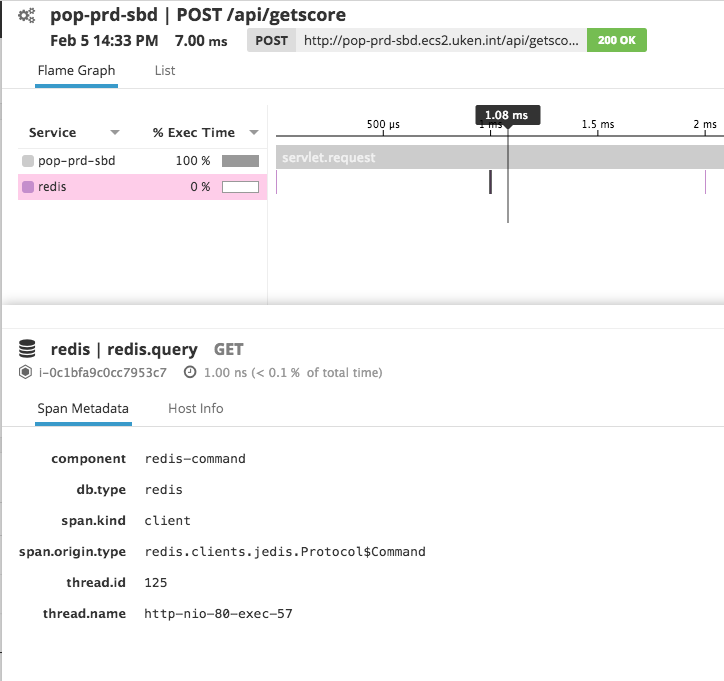
At first I thought maybe the method being instrumented wasn't doing any io which would explain the very low
1nsrecorded time for the redis span, but after looking at the Jedis code it looks like IO is included insendCommand. Also, other APM tools instrument the same method I did here: e.g.: https://github.com/glowroot/glowroot/blob/master/agent/plugins/redis-plugin/src/main/resources/META-INF/glowroot.plugin.jsonFinally, I see similar numbers in New Relic.